Tree Pruning and Tree Lopping
Difference Between Tree Pruning and Tree Lopping: Guide 2026
Trees add shade, character and natural beauty to Melbourne properties. Whether you have a mature eucalyptus in your backyard, an ornamental tree near your driveway or established trees surrounding your home, regular assessment and appropriate maintenance can help keep your outdoor space safe and functional.
However, when branches become overgrown or damaged, homeowners often face an important question: should the tree be pruned or lopped?
Although these terms are sometimes used interchangeably, they do not necessarily describe the same type of work.
Understanding the difference between tree pruning and tree lopping is important because the method used can affect a tree’s health, appearance, structural integrity and future maintenance requirements.
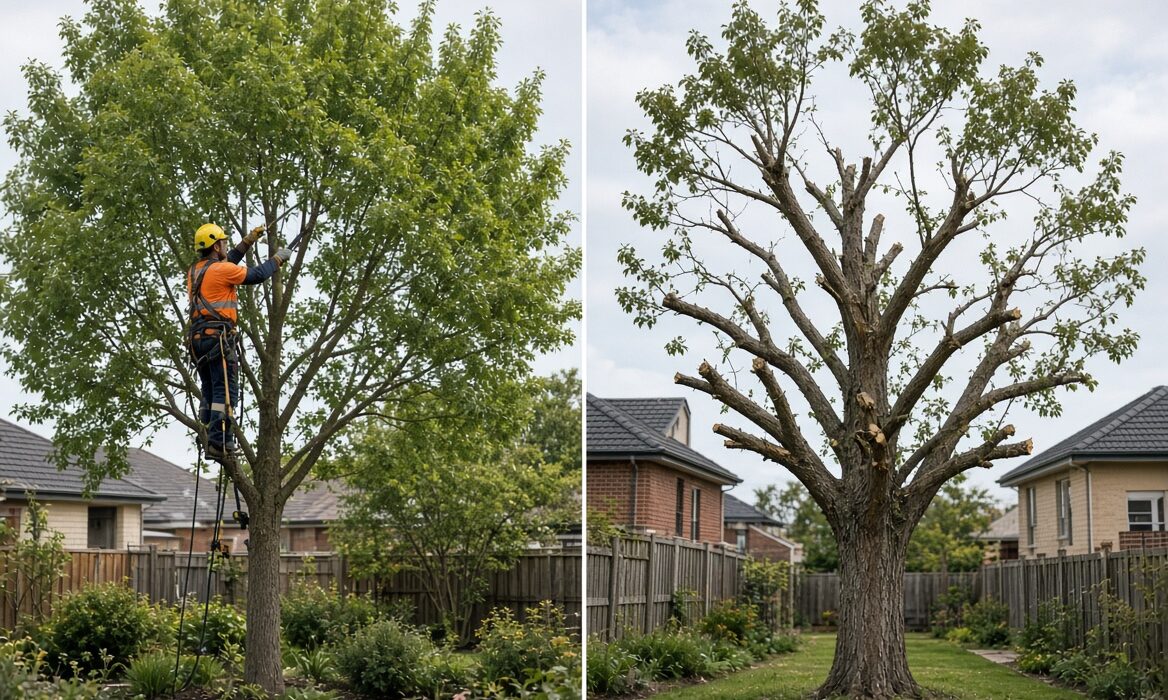
Tree pruning generally involves carefully selected cuts made for a specific purpose, such as removing dead branches, improving clearance or managing structural defects. Tree lopping, particularly when used to describe indiscriminate cutting or topping, often involves removing substantial sections of a tree without following recognised pruning principles.
While appropriate pruning can support tree management, excessive lopping may cause long-term damage and create additional safety concerns.
For Melbourne homeowners, choosing the right approach also involves considering local tree protection rules, surrounding buildings, wildlife and the condition of the tree.
In this guide, we explain how tree pruning and tree lopping differ, when each term is used, why professional tree care matters and what to consider before arranging work.
At Aussie Tradies Group, we help property owners with suitable tree and stump removal projects across Melbourne. Understanding tree maintenance options can help you decide when professional assessment, pruning or removal may be necessary.
What Is Tree Pruning?
Tree pruning is the selective removal of branches or other plant material to achieve a defined tree management objective.
Rather than simply reducing the overall size of a tree, appropriate pruning considers its species, growth pattern, condition and structure.
Professional pruning techniques aim to address specific concerns while retaining as much healthy, functional tree structure as practical.
Common Reasons for Tree Pruning
Tree pruning may be recommended to:
- Remove dead or broken branches.
- Improve clearance from buildings or pathways.
- Address selected structural defects.
- Manage branches affected by damage.
- Encourage appropriate structural development in young trees.
- Maintain suitable canopy form.
- Reduce particular risks identified during assessment.
Not every tree requires routine pruning. Some healthy, established trees can remain suitable without frequent cutting.
How Is Professional Tree Pruning Performed?
Pruning involves identifying the branches that need attention and selecting appropriate cutting points.
The operator considers branch attachments, tree structure and the amount of foliage being removed.
Suitable techniques depend on the tree species and the purpose of the work.
Does Pruning Make a Tree Healthier?
Appropriate pruning can support certain tree management goals, but pruning is not automatically beneficial in every situation.
Unnecessary or excessive pruning can stress a tree.
The best approach is based on an identified need.
What Is Tree Lopping?
Tree lopping is a broad term commonly used to describe cutting branches or reducing the size of a tree.
In everyday Australian usage, some homeowners use the term to refer to almost any major tree cutting work.
However, arborists often use lopping to describe cutting large branches or stems back to unsuitable points, particularly where the natural structure of the tree is not considered.
This can include topping a tree or removing substantial sections of its canopy.
How Is Tree Lopping Different?
Unlike carefully planned pruning, indiscriminate lopping may focus mainly on reducing height or size.
Large branches may be cut without suitable regard for branch attachments or future growth.
Why Do People Request Tree Lopping?
Common reasons include:
- A tree has become very tall.
- Branches extend over a roof.
- The canopy blocks sunlight.
- The tree appears too large for the garden.
- Homeowners are concerned about storm damage.
- The tree interferes with an outdoor renovation.
These concerns may be legitimate, but lopping is not necessarily the correct solution.
Is All Work Described as Lopping Harmful?
Not necessarily.
The word lopping is sometimes used informally to describe legitimate pruning.
What matters is the actual method proposed, where cuts will be made and how the work will affect the tree.
A qualified arborist can explain the appropriate technique.
Difference Between Tree Pruning and Tree Lopping
The main difference between tree pruning and tree lopping lies in the purpose, cutting method and consideration given to the tree’s long-term condition.
| Feature | Tree pruning | Indiscriminate tree lopping |
|---|---|---|
| Main purpose | Manage defined tree needs | Often reduce size quickly |
| Cutting method | Selected cuts at appropriate locations | Large cuts may be made at unsuitable points |
| Tree structure | Considers natural growth and attachments | May disrupt natural structure |
| Foliage removal | Limited according to objectives and tree condition | Can remove excessive canopy |
| Regrowth | Managed according to species and technique | May encourage vigorous, weakly attached shoots |
| Long-term impact | Can support responsible tree management | Can increase future maintenance problems |
| Professional preference | Appropriate pruning methods | Generally discouraged when indiscriminate |
The distinction is not simply how much wood is removed. It is whether the work follows appropriate arboricultural principles.
Key Difference 1: Purpose of the Work
Tree pruning begins with a specific objective.
For example, an arborist may identify a damaged branch above a frequently used driveway and recommend its removal.
The work is limited to addressing that concern.
Tree lopping may instead involve reducing large portions of the canopy without a clearly defined structural objective.
Pruning Focuses on Identified Needs
The purpose may be to improve clearance, remove damaged branches or manage selected structural issues.
Lopping Often Focuses on Size Reduction
Indiscriminate lopping may be requested because the tree looks too large.
However, a large tree is not automatically unsafe.
Why This Difference Matters
Removing branches without a clear reason can create unnecessary wounds and alter the tree’s structure.
Key Difference 2: Cutting Techniques
The location and quality of cuts are important aspects of tree care.
Selective Pruning Cuts
Appropriate pruning generally involves cuts selected according to branch structure and the intended outcome.
The technique should minimise unnecessary damage.
Large Lopping Cuts
Indiscriminate lopping may leave large exposed cuts or remove branches without suitable consideration of natural growth points.
Tree Response to Cutting
Trees respond to pruning wounds differently depending on species, condition and cut location.
Poorly positioned cuts can increase the potential for decay or undesirable regrowth.
Why Professional Knowledge Matters
A qualified arborist can determine which branches should be removed and how the work should be performed.
Key Difference 3: Effects on Tree Health
Tree health is an important consideration when comparing pruning and lopping.
Pruning and Tree Function
Appropriate pruning aims to retain sufficient healthy foliage and functional structure.
Excessive Foliage Removal
Removing too much canopy can reduce the tree’s ability to produce energy through photosynthesis.
Large Wounds
Large cuts may expose internal wood and increase the potential for decay.
Long-Term Stress
Severe cutting can stress trees, particularly when they are already affected by drought, disease or environmental conditions.
Tree Species Matter
Different species respond differently to pruning.
A method suitable for one species may be inappropriate for another.
Key Difference 4: Structural Safety
A major reason homeowners arrange tree work is to address safety concerns.
However, not all cutting methods improve safety.
Pruning Can Manage Selected Hazards
Removing a damaged branch may eliminate the risk associated with that branch.
Other parts of the tree should still be considered.
Lopping Can Create Weak Regrowth
Heavy cutting may stimulate shoots near the cut areas.
Depending on the species and attachment, some regrowth may be structurally weaker.
Uneven Canopy Reduction
Poorly planned cutting can change how loads are distributed across the tree.
Future Branch Failure
Weakly attached regrowth may require monitoring and further management.
This is why professional assessment is important before major canopy reduction.
Key Difference 5: Appearance and Landscape Value
Trees contribute to the character of residential properties.
The visual effect of pruning and lopping can differ significantly.
Natural Tree Form
Appropriate pruning generally aims to respect the tree’s natural structure.
Balanced Canopy
Selective work can help manage certain branches without unnecessarily altering the entire canopy.
Lopped Tree Appearance
Heavy lopping may leave blunt branch ends and an uneven or reduced canopy.
Regrowth Patterns
New shoots may emerge around large cuts, changing the tree’s appearance over time.
Property Landscaping
A well-considered tree management plan should balance safety, tree condition and landscape objectives.
Key Difference 6: Long-Term Maintenance
The initial cutting work is only one part of tree management.
Pruned Trees
Some trees require periodic reassessment, while others may need little further intervention.
Lopped Trees
Trees affected by heavy cutting may produce regrowth requiring additional monitoring.
Ongoing Costs
Repeated corrective work can increase long-term maintenance expenses.
Professional Monitoring
An arborist can recommend an appropriate inspection schedule based on the tree’s condition.
Different Types of Tree Pruning
Professional pruning is not a single technique.
The appropriate method depends on the objective and tree characteristics.
Deadwood Removal
Deadwood removal involves removing selected dead branches.
This may be appropriate where falling branches create risks to people or property.
Crown Lifting
Crown lifting involves removing selected lower branches to improve clearance.
It may be used near pathways, driveways or entrances.
The amount removed should be appropriate for the tree.
Crown Thinning
Crown thinning involves selective branch removal within the canopy.
It should not be confused with indiscriminately stripping interior branches.
The suitability of thinning depends on the species and management objective.
Crown Reduction
Crown reduction involves reducing selected branches using appropriate pruning techniques.
It may be considered where size management is justified.
This is different from simply topping the tree.
Formative Pruning
Formative pruning is commonly associated with younger trees.
It aims to encourage suitable structural development.
Structural Pruning
Structural pruning addresses selected branch arrangements or defects to support long-term tree management.
Why Tree Topping Is Different from Proper Pruning
Tree topping is a form of severe canopy reduction that removes the upper portions of stems or major branches.
It is often confused with professional crown reduction.
Topping Removes Major Sections
Topping can leave large cuts and significantly reduce foliage.
Regrowth Can Be Problematic
Some trees respond by producing numerous shoots around the cut areas.
Tree Health May Decline
Severe foliage removal and large wounds can place stress on the tree.
Proper Reduction Uses Selected Cuts
Professional crown reduction considers suitable branch attachments and the tree’s remaining structure.
Topping Is Not a Guaranteed Safety Solution
Reducing a tree’s height through indiscriminate topping does not automatically make it safer.
It may create future maintenance and structural concerns.
Which Method Is Better for Tree Safety?
For trees that can be retained, appropriate professional pruning is generally preferable to indiscriminate lopping.
However, the correct action depends on the tree’s condition and the hazard being addressed.
Dead Branches
Selected deadwood removal may be appropriate.
Branches Near Buildings
Clearance pruning may help manage contact with structures.
Structural Defects
An arborist may recommend pruning, monitoring or other management measures.
Severe Tree Damage
A tree with major trunk failure or root instability may require removal.
Healthy Large Trees
A healthy large tree may not need cutting simply because of its height.
Tree Pruning and Storm Damage Prevention
Storms are an important consideration for Melbourne property owners.
Strong winds can damage branches and trunks, while heavy rainfall may affect soil conditions.
Removing Damaged Branches
Selected pruning can address branches with identified damage.
Managing Previous Storm Damage
Trees that have lost major limbs may require professional assessment.
Checking Root Stability
Pruning does not resolve every root-related problem.
A tree with significant root movement may require a different approach.
Avoiding Excessive Canopy Removal
Heavy lopping is not a reliable substitute for proper tree risk assessment.
Understanding Limitations
Even a well-maintained tree can be damaged by extreme weather.
No pruning method guarantees protection against all storms.
When Should You Prune a Tree?
Pruning may be appropriate when there is a clear reason for the work.
Dead or Broken Branches
Branches that are dead or damaged may require attention, especially above occupied areas.
Clearance Problems
Selected branches may interfere with paths, driveways or structures.
Young Tree Development
Formative pruning can help manage the structure of some young trees.
Structural Defects
Certain defects may be managed through appropriate pruning.
Following Storm Damage
A professional assessment can help determine whether damaged branches should be removed.
When Should You Avoid Tree Lopping?
Indiscriminate lopping should generally be avoided because of its potential effects on tree structure and health.
When the Tree Is Healthy
A healthy tree does not automatically need severe size reduction.
When Height Is the Only Concern
Tree height alone does not establish that a tree is dangerous.
When Cutting Would Remove Excessive Foliage
Heavy canopy loss can stress a tree.
When the Tree Is Protected
Significant cutting may be restricted by council or planning requirements.
When the Work Is Near Power Lines
Electrical infrastructure requires special precautions and authorised personnel.
When the Proposed Method Is Unclear
Ask the contractor to explain exactly what branches will be removed and why.
Tree Pruning vs Tree Lopping Costs in Melbourne
The cost of tree work depends on the actual scope rather than the label used.
A quotation for pruning one damaged branch cannot be directly compared with a quotation for major canopy reduction.
Tree Size
Larger trees may require additional equipment and time.
Height and Access
Working at height or in restricted spaces can increase complexity.
Branch Size
Large branches may require controlled removal methods.
Nearby Buildings
Work near roofs, fences and other structures may require additional planning.
Equipment
Elevated work platforms, specialist rigging and other equipment can affect costs.
Debris Removal
The volume of material and disposal arrangements may influence the quotation.
Tree Condition
Damaged or unstable trees can require more complex safety measures.
Council Approvals
Where permits or specialist assessments are required, additional costs may apply.
The most useful approach is to request a quotation describing the specific work rather than relying on a generic price for tree lopping.
Does Tree Pruning Require Council Permission in Melbourne?
Tree protection rules vary between Melbourne councils and individual properties.
Some trees are protected by local laws, planning overlays or permit conditions.
Protected Trees
Certain trees may be subject to restrictions because of their size, species, location or significance.
Heritage Properties
Trees on properties affected by heritage controls may require additional consideration.
Significant Branch Removal
Some forms of pruning may require approval, depending on the relevant rules.
Emergency Tree Work
Emergency exemptions may exist in certain circumstances, but the applicable conditions should be checked.
Before Starting Work
Contact the relevant local council or planning authority if you are unsure about the rules.
What About Trees Near Power Lines?
Tree work near electrical infrastructure is particularly hazardous.
Electrical Contact
Branches may conduct electricity when in contact with energised infrastructure.
Clearance Requirements
Vegetation clearance requirements depend on the electrical network and relevant regulations.
Authorised Workers
Work near power lines may require appropriately trained and authorised personnel.
Fallen Power Lines
Never approach or touch a fallen power line or a tree in contact with one.
Contact the electricity distributor or emergency services as appropriate.
Can You Prune or Lop a Tree Yourself?
Minor gardening tasks are different from major tree work.
Large branches, chainsaws and working at height create serious risks.
Ladder Hazards
Using a ladder while cutting branches can cause falls.
Falling Branches
Large limbs may swing or fall unpredictably.
Chainsaw Risks
Chainsaws require appropriate skills and protective equipment.
Tree Damage
Incorrect cuts can affect tree health and structure.
Electrical Risks
Never attempt tree work near electrical infrastructure without appropriate authorisation.
For significant pruning or uncertain tree conditions, professional assistance is recommended.
How to Choose a Tree Care Professional
Selecting a suitable contractor is an important part of responsible tree management.
Ask About Qualifications
For major pruning and tree assessment, consider an appropriately qualified arborist.
Discuss the Proposed Method
Ask whether the work involves deadwood removal, clearance pruning, crown reduction or another technique.
Request an Explanation
The contractor should be able to explain why particular branches need attention.
Confirm Insurance
Ask about appropriate insurance for the proposed work.
Check Council Requirements
Clarify who is responsible for any necessary approvals.
Get a Written Quote
A quotation should identify the work, exclusions and debris arrangements.
Consider Long-Term Tree Health
The proposal should consider the condition of the remaining tree.
When Is Complete Tree Removal More Appropriate?
Pruning cannot resolve every tree-related problem.
Some trees are too severely damaged or structurally compromised to retain safely.
Major Trunk Failure
Extensive trunk splitting can affect stability.
Significant Root Damage
A tree with severe root instability may require removal.
Advanced Structural Decay
Extensive decay affecting major supporting structures may limit management options.
Severe Storm Damage
A tree that has lost major structural sections may require professional removal.
Approved Construction Work
Some development projects may require removal where permitted.
A qualified arborist can assess whether removal is necessary.
What Happens to the Stump After Tree Removal?
After a tree is removed, the stump usually remains unless stump work is included.
The property owner may choose to retain, grind or remove it depending on future landscaping plans.
Stump Grinding
Stump grinding reduces the visible stump to wood chips using specialist equipment.
Most underground roots generally remain.
Complete Stump Removal
Complete removal may involve excavating the stump and major root mass.
Landscaping Preparation
The appropriate method depends on whether the area will be used for lawn, planting, paving or construction.
Professional Stump Services
Aussie Tradies Group provides tree and stump removal services for suitable Melbourne properties.
Tree Care Considerations for Melbourne Homes
Melbourne properties have different tree management needs depending on their location, design and surrounding vegetation.
Established Residential Gardens
Mature trees may require periodic assessment, particularly after storms or visible structural changes.
Compact Urban Properties
Trees growing near buildings and boundaries may require careful clearance planning.
Large Residential Blocks
Properties with several mature trees may benefit from a coordinated maintenance plan.
Rental Properties
Property managers may need to arrange assessments when tenants report damaged branches.
Commercial Sites
Businesses may need to consider trees near entrances, parking areas and pedestrian routes.
The objective is to manage identified risks without unnecessary damage to healthy trees.
Common Mistakes When Comparing Pruning and Lopping
Homeowners sometimes make decisions based on terminology rather than the actual work proposed.
Assuming Both Methods Are Identical
The words may be used interchangeably, but the cutting techniques can differ.
Believing a Smaller Tree Is Always Safer
Reducing tree size does not automatically eliminate risk.
Ignoring Tree Species
Different trees respond differently to cutting.
Removing Too Much Foliage
Excessive canopy removal can stress trees.
Choosing the Cheapest Quote Without Reviewing the Scope
The proposed method, qualifications and safety planning matter.
Forgetting Council Rules
Protected trees may require approval before significant work.
Ignoring Future Regrowth
Heavy lopping may create additional maintenance requirements.
Why Responsible Tree Management Matters
Trees provide benefits that extend beyond their appearance.
They can contribute shade, habitat, landscape character and environmental value.
Responsible tree management aims to retain these benefits while addressing identified hazards.
Protecting Property
Appropriate pruning may help manage selected branches near buildings and access areas.
Supporting Tree Health
Avoiding unnecessary cuts can help retain healthy foliage and structure.
Managing Safety
Professional assessment can identify hazards that require attention.
Reducing Unnecessary Removal
Some trees can be retained through appropriate management.
Planning for the Future
Tree care decisions should consider long-term growth and maintenance requirements.
Frequently Asked Questions About Tree Pruning vs Tree Lopping
1. What is the main difference between tree pruning and tree lopping?
Tree pruning involves selective cutting for defined management objectives. Indiscriminate tree lopping often involves removing large sections of a tree without appropriate consideration of structure or natural growth.
2. Is tree pruning better than tree lopping?
For trees suitable for retention, appropriate pruning is generally preferable to indiscriminate lopping because it considers tree structure, health and long-term management.
3. Does tree lopping damage trees?
Excessive or poorly performed lopping can stress trees, create large wounds and encourage potentially weak regrowth.
4. Can pruning prevent branches from falling?
Pruning can remove selected hazardous branches, but it cannot guarantee that no branches will fall in the future.
5. How often should a tree be pruned?
There is no universal schedule. The need depends on species, age, condition and location.
6. Is tree topping the same as pruning?
No. Topping involves severe reduction of stems or branches and is generally different from recognised pruning methods.
7. Can a large tree be reduced safely?
In some circumstances, a qualified arborist may recommend appropriate crown reduction. Suitability depends on the tree’s condition and species.
8. Do I need permission to prune a tree in Melbourne?
Possibly. Council and planning requirements vary depending on the property and tree.
9. Is tree lopping cheaper than pruning?
Not necessarily. Cost depends on the work required, access, equipment and disposal arrangements.
10. Can I prune branches touching my roof?
Branches close to roofs may require clearance, but major work should be assessed and carried out using suitable methods.
11. What happens if a tree cannot be saved?
A qualified arborist may recommend removal where safe retention is not practical.
12. Does stump grinding come after tree pruning?
Not usually. Stump grinding is generally considered after a tree has been removed, not after routine pruning.
Final Thoughts: Understanding the Difference Between Tree Pruning and Tree Lopping
The difference between tree pruning and tree lopping is more than a matter of terminology.
Appropriate tree pruning uses selected cuts to achieve defined objectives while considering the tree’s health, structure and future growth.
Indiscriminate lopping can remove excessive foliage, create large wounds and lead to potentially weak regrowth.
For Melbourne homeowners, the best decision depends on the condition of the tree, the risks involved and the proposed work.
A qualified arborist can help determine whether pruning, monitoring or removal is appropriate.
Responsible tree management protects the value of healthy trees while addressing genuine property safety concerns.