Can Stump Grinding Be Done on Uneven or Sloping Ground?
Yes, stump grinding can be done on uneven or sloping ground when the terrain is suitable for safe machinery operation. Professional stump grinding contractors assess the slope, soil stability, stump position and equipment access before deciding how to complete the job.
Removing a tree stump from a flat lawn is usually straightforward. However, sloping gardens, uneven backyards and properties with raised ground levels can create additional challenges. The machinery needs a stable working position, sufficient access and enough clearance to grind the stump without damaging nearby structures or landscaping.
Whether you have a tree stump on a sloping lawn, an uneven backyard or a difficult garden area, choosing the right stump grinding approach can make the removal process safer and more efficient.
At Aussie Tradies Group, we understand that every outdoor space has different ground conditions. This guide explains how stump grinding works on uneven surfaces, what challenges homeowners should consider and how professional contractors approach difficult stump removal projects.
What Is Stump Grinding?
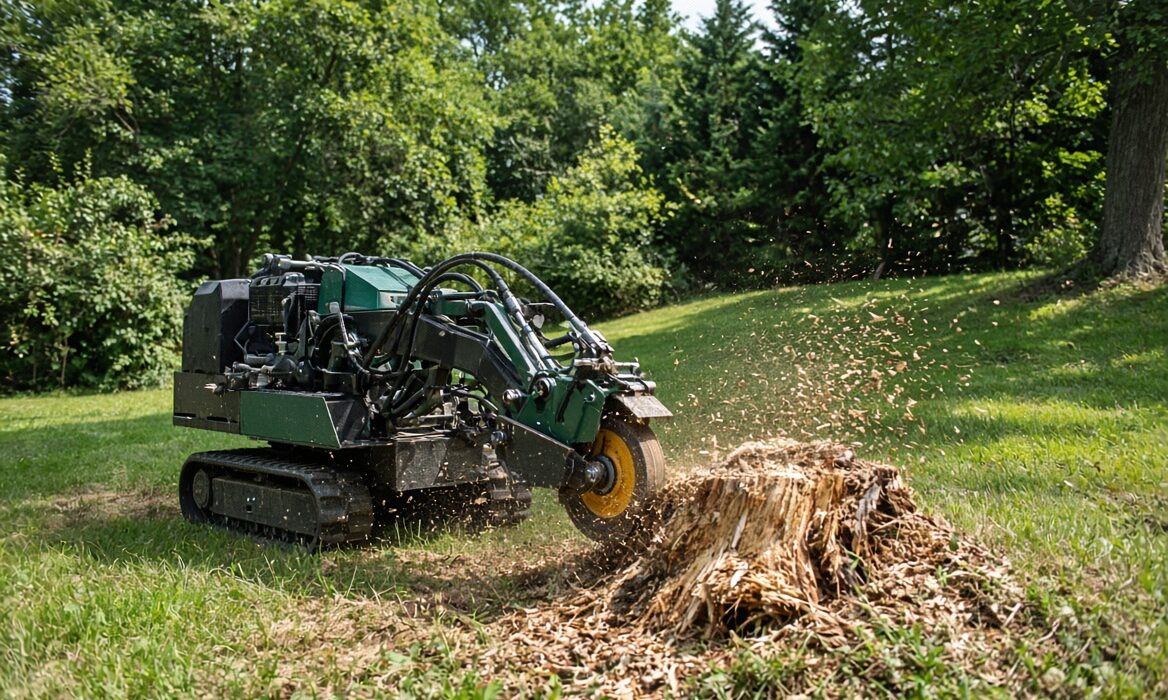
Stump grinding is a tree stump removal method that uses specialised machinery to break down the remaining tree stump into small wood chips.
The machine has a rotating cutting wheel fitted with sharp teeth. The operator moves the cutting wheel across the stump, gradually grinding the wood below the surrounding ground level.
Unlike complete stump extraction, stump grinding does not usually require removing the entire underground root system. This makes it a practical option for many residential gardens where extensive excavation could disturb surrounding landscaping.
The general stump grinding process includes:
- Inspecting the tree stump and surrounding ground.
- Assessing machinery access and soil stability.
- Checking for underground pipes, cables and other obstacles.
- Positioning the stump grinder safely.
- Grinding the stump in controlled stages.
- Managing the resulting wood chips and debris.
- Preparing the area for future landscaping.
Can Stump Grinding Be Done on Sloping Ground?
Yes, stump grinding is possible on many sloping properties. However, the suitability of the ground depends on the gradient, soil condition, machine specifications and available access.
Not every slope presents the same challenges. A slightly sloping backyard may allow conventional stump grinding equipment to operate safely, while a steep hillside with loose soil may require specialist equipment or an alternative approach.
1. Stump Grinding on Gentle Slopes
Gentle slopes are generally easier to manage because machinery can often be positioned on relatively stable ground.
The operator assesses the direction of the slope and identifies the safest position for approaching the stump.
Important considerations include:
- Maintaining stable equipment positioning.
- Checking soil firmness and surface conditions.
- Ensuring enough working space around the stump.
- Identifying exposed roots and other obstacles.
- Keeping the machine within its operating limits.
With suitable access and ground conditions, stump grinding on a gentle slope can often be completed without extensive site preparation.
2. Stump Grinding on Steep Slopes
Steep slopes require more careful planning because gravity, soil movement and limited traction can affect machinery stability.
Loose soil, wet grass, exposed roots and erosion can make it difficult to position equipment securely.
Before starting work, contractors assess whether the slope is suitable for the selected stump grinder.
Depending on the site, they may need specialist equipment, a different access route or additional ground preparation.
Safety should always take priority. If the slope exceeds the machine manufacturer’s operating limits, stump grinding should not proceed using that equipment.
3. Stump Grinding on Uneven Garden Surfaces
Uneven ground may contain raised soil, depressions, exposed roots, rocks and compacted sections.
These conditions can affect how machinery moves around the stump.
Professional contractors inspect the surrounding area and determine the most practical approach. Where possible, they select a stable access route and position the equipment to minimise unnecessary movement across uneven surfaces.
What Challenges Affect Stump Grinding on Uneven Ground?
Several factors can influence the difficulty, preparation time and safety of stump grinding on uneven or sloping properties.
1. Loose or Unstable Soil
Loose soil can shift under the weight of machinery, affecting traction and stability.
Sandy soil, recently disturbed ground and areas affected by erosion may require additional assessment before grinding begins.
2. Wet and Muddy Conditions
Rain can make sloping surfaces slippery and reduce the traction available to stump grinding machinery.
Waterlogged soil may also become soft, increasing the risk of equipment sinking or losing stability.
In these situations, contractors may recommend postponing the work until the ground becomes firmer.
3. Limited Machinery Access
Some tree stumps are located behind narrow gates, fences, retaining walls or garden structures.
Even if the stump itself is accessible, getting the required equipment into position may be difficult.
Contractors need to consider:
- Gate and pathway widths.
- Available turning space.
- Steps and changes in elevation.
- Nearby fences and structures.
- The machine’s overall dimensions.
4. Exposed Tree Roots
Large surface roots can create an uneven working area and make equipment positioning more complicated.
The operator should inspect the location of major roots before grinding to reduce the risk of disturbing nearby structures, pathways or underground services.
5. Nearby Structures and Landscaping
Stumps located near retaining walls, garden edging, paved areas and fences require careful planning.
The grinding process should be controlled to minimise unnecessary disturbance to surrounding landscaping.
What Equipment Is Used for Stump Grinding on Sloping Ground?
The equipment depends on the stump size, terrain, access conditions and the manufacturer’s operating specifications.
1. Compact Stump Grinders
Compact stump grinders are designed for smaller working areas and restricted access.
They can be useful for residential properties where larger machinery cannot easily reach the stump.
2. Tracked Stump Grinders
Tracked stump grinders use tracks instead of conventional wheels.
Depending on the model, they can provide better traction and distribute machine weight across a larger contact area.
They may be suitable for certain uneven garden surfaces, but they are not automatically safe on steep slopes. The manufacturer’s operating instructions must always be followed.
3. Larger Professional Stump Grinders
Larger machines are commonly used for substantial tree stumps and demanding projects.
They offer greater cutting capacity but require sufficient access and suitable working conditions.
The contractor should select machinery according to the actual terrain rather than simply choosing the largest available machine.
How Do Professionals Prepare Uneven Ground for Stump Grinding?
Proper preparation helps make stump grinding more manageable and reduces unnecessary risks.
1. Inspect the Working Area
The contractor examines the stump and surrounding ground to identify:
- Steep gradients and changes in ground level.
- Loose soil and erosion.
- Underground pipes and electrical services.
- Exposed roots and rocks.
- Retaining walls and nearby structures.
- Access restrictions.
A site inspection helps determine whether the ground is suitable for the intended equipment. nptc.org.uk+1
2. Identify a Suitable Access Route
The machinery needs a safe route from the property entrance to the stump.
Contractors consider pathway widths, turning space, ground firmness and elevation changes.
If access is too narrow or unstable, alternative equipment or another removal approach may be necessary.
3. Check Soil and Weather Conditions
Wet soil, loose gravel and recently disturbed ground can affect machine stability.
If conditions are unsuitable, postponing the work may be the safest option.
4. Protect Surrounding Landscaping
Protective barriers or debris screens may be used to help prevent flying wood chips from damaging nearby windows, vehicles and garden features.
Underground services should also be identified before grinding below ground level.
What Happens When a Tree Stump Is Near a Retaining Wall?
Tree stumps located near retaining walls require additional attention, particularly when the property has sloping ground.
Large roots may extend beneath or alongside the structure. Grinding should be planned carefully to avoid disturbing supporting soil or damaging the wall.
Assess the Root Location
Contractors examine visible roots and consider whether they extend towards the retaining wall.
Cracks, movement or signs of soil pressure should also be assessed.
Choose an Appropriate Grinding Depth
The required depth depends on the intended use of the area.
Preparing a garden bed may require a different finish from preparing a lawn or landscaping area.
However, contractors should not grind blindly beneath retaining structures.
Protect the Surrounding Structure
The objective is to reduce the stump without unnecessarily disturbing nearby soil.
Where a stump is extremely close to a retaining wall, specialist assessment may be necessary before work proceeds.
How Deep Can a Stump Be Ground on Uneven Ground?
The achievable grinding depth depends on stump position, soil conditions, machinery design and accessibility.
The required depth should also reflect what the homeowner intends to do with the area afterwards.
| Intended use | Grinding considerations |
|---|---|
| Lawn installation | Grind sufficiently below the planned soil level |
| Garden beds | Consider planting depth and available soil |
| Landscaping | Coordinate grinding depth with finished ground levels |
| Construction | Assess remaining roots and ground conditions |
Stump grinding does not normally remove the entire underground root system. Larger roots may remain below the surface and gradually decay.
Can Stump Grinding Damage Your Lawn or Garden on a Slope?
Stump grinding can disturb surrounding soil and vegetation, especially when machinery needs to travel across uneven ground.
However, suitable equipment and careful preparation can help minimise unnecessary damage.
Protecting Existing Grass
If the stump is located in a landscaped lawn, contractors should consider the access route and avoid unnecessary movement across healthy grass.
Ground protection may also be appropriate depending on the machinery and surface conditions.
Protecting Garden Beds
Plants, shrubs and decorative features close to the stump should be identified before work begins.
Some plants may need temporary protection or relocation if they are within the working area.
Managing Wood Chips and Soil
Grinding produces wood chips and debris.
These materials can be collected or managed according to the landscaping plan. If the area will be replanted, suitable topsoil may need to be added afterwards.
What Are the Signs That a Sloping Area Is Not Suitable for Stump Grinding?
Not every stump can be safely ground using conventional equipment.
A contractor may recommend postponing the work or considering another method if the property has:
- Extremely steep or unstable terrain.
- Soft soil that cannot support the machinery.
- Severe erosion around the stump.
- A risk of machinery sliding or overturning.
- Insufficient access for the required equipment.
- Underground services within the intended grinding area.
- Retaining structures that could be affected by the work.
There is no universal safe slope angle for every stump grinder. Each machine has its own operating restrictions, which must be followed. atoolshed.com+2
Stump Grinding vs Complete Stump Removal on Sloping Ground
Both methods deal with unwanted tree stumps, but their processes are different.
| Feature | Stump Grinding | Complete Stump Removal |
|---|---|---|
| Main process | Grinds stump into wood chips | Extracts stump and major roots |
| Ground disturbance | Generally more limited | Usually more extensive |
| Root system | Most underground roots remain | Larger root sections may be removed |
| Landscaping | Suitable for many garden projects | May require additional soil restoration |
| Sloping ground | Requires stable machine positioning | Excavation may disturb sloping soil |
For many residential properties, stump grinding is a practical option because it reduces the visible stump without requiring extensive excavation.
The best method depends on the location, ground conditions and intended use of the area.
How to Prepare Your Property Before a Stump Grinding Service
Homeowners can make the process easier by preparing the working area before the contractor arrives.
Clear the Surrounding Area
Remove garden furniture, pots, toys, tools and other movable objects from around the stump.
Identify Underground Services
Provide any available information about irrigation pipes, drainage systems, electrical cables and other underground installations.
Explain Access Restrictions
Inform the contractor about narrow gates, steps, retaining walls and other obstacles that could affect machinery access.
Discuss Your Landscaping Plans
Explain whether you intend to install new grass, create a garden bed or use the area for another purpose.
This helps determine the appropriate grinding depth and how the resulting wood chips should be managed.
Keep Children and Pets Away
Keep children, pets and other people away from the working area while machinery is operating.
Frequently Asked Questions
Can a tree stump be ground on a steep hill?
Yes, some tree stumps on steep hills can be ground using suitable professional equipment. However, contractors must assess the slope, soil stability and machine operating limits before starting.
Can stump grinding machines work on wet ground?
Some machines can operate on mildly damp surfaces, but muddy or waterlogged ground can reduce traction and increase the risk of sliding. Contractors may recommend waiting until the soil becomes firmer.
Is a tracked stump grinder better for sloping ground?
Tracked stump grinders can provide better traction on certain uneven surfaces. However, suitability depends on the equipment specifications, slope and soil conditions.
Can stump grinding be done in a sloping backyard?
Yes. Many sloping backyards can accommodate stump grinding if there is sufficient access and a stable working position.
Does stump grinding remove tree roots on a slope?
Stump grinding removes the visible stump and can grind accessible surface roots. It does not normally remove the entire underground root system.
Will stump grinding cause soil erosion on a hillside?
The process can disturb soil around the stump. On vulnerable slopes, contractors should consider soil stability, drainage and future landscaping to minimise erosion.
How long does stump grinding take on uneven ground?
The duration depends on stump diameter, wood hardness, root structure, equipment access and ground conditions. Uneven terrain may increase preparation and positioning time.
Should I level the ground before stump grinding?
Not always. Minor surface irregularities may not require levelling, but unstable ground or significant elevation changes may need attention before machinery can operate safely.
Final Thoughts
Stump grinding can be completed on many uneven and sloping properties, but the ground must be assessed before work begins.
Factors such as slope steepness, soil stability, machinery access, exposed roots and nearby structures all influence the appropriate approach.
Gentle slopes and moderately uneven gardens may be manageable with suitable equipment. However, steep, muddy or unstable surfaces can create serious operating risks and may require additional preparation or an alternative removal method.
Professional site assessment helps determine the safest and most practical solution for your property.
At Aussie Tradies Group, we understand the importance of careful planning when dealing with tree stumps in challenging outdoor spaces.