Stump Grinding
Professional Stump Grinding Services in Melbourne: Cost in 2026
Removing a tree is often only the first step in reclaiming your outdoor space. Once the trunk and branches are gone, the remaining stump can make landscaping difficult, interfere with lawn maintenance and prevent you from using your garden the way you want.
Whether you have an old tree stump in the backyard, several stumps left after a garden renovation or a large stump close to a driveway, professional stump grinding can help prepare the area for its next use.
For Melbourne homeowners, understanding the stump grinding process and the factors affecting its cost makes it easier to plan a project and compare quotations.
Stump grinding Melbourne services generally involve using specialist machinery to reduce the visible stump to wood chips, usually to an agreed depth below ground level. Unlike complete stump excavation, grinding normally leaves the deeper root system in place to break down over time.
At Aussie Tradies Group, we help Melbourne property owners with suitable tree and stump removal projects. This guide explains how stump grinding works, what it may cost, how long it takes and what to consider before arranging the work.
What Is Stump Grinding?
Stump grinding is a mechanical process used to reduce a tree stump into smaller wood chips.
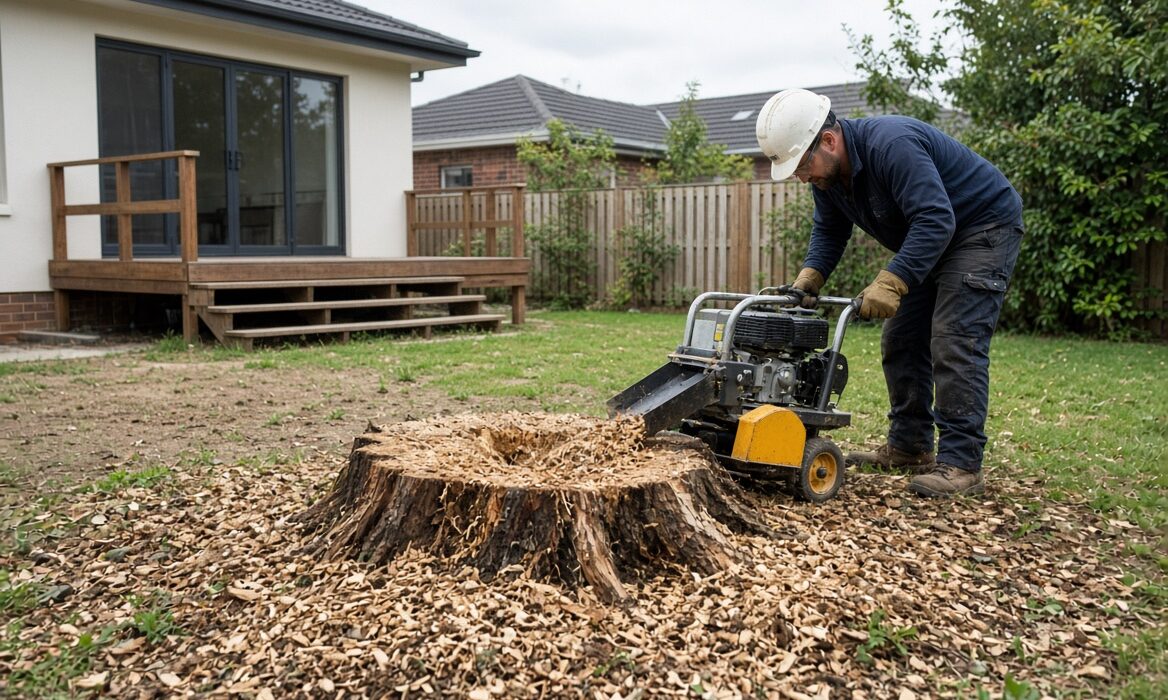
A specialised machine called a stump grinder has a rotating cutting wheel fitted with durable teeth. The operator moves the wheel across the stump in controlled passes, gradually reducing the wood.
The grinding process can continue below the surrounding ground level, depending on the required depth, equipment capabilities and site conditions.
After grinding, the area contains a mixture of wood chips, soil and remaining underground roots.
The chips may be removed or managed on-site according to the agreed scope of work.
How Does a Stump Grinder Work?
A stump grinder uses a high-speed cutting wheel to break down the stump.
The operator positions the machine near the stump and progressively cuts through the timber.
The cutting wheel moves across the exposed wood until the required material has been removed.
The work requires appropriate protective equipment, controlled access and checks for underground hazards.
Does Stump Grinding Remove the Entire Tree?
No. Stump grinding generally removes the visible stump and a selected amount of wood below ground level.
The deeper roots usually remain underground.
If a project requires complete root-ball excavation, a different removal method may be necessary.
Why Do Homeowners Choose Stump Grinding?
Stump grinding is commonly selected because it can remove an unwanted stump without excavating the entire root system.
It may be suitable when homeowners want to:
- Restore an area of lawn.
- Prepare an existing garden bed.
- Remove an obstacle from a backyard.
- Improve access for landscaping.
- Address a protruding stump near a pathway.
- Clear space for suitable new planting.
- Remove multiple old stumps from a property.
The appropriate method depends on the planned use of the area.
How Much Does Stump Grinding Cost in Melbourne?
Stump grinding costs in Melbourne vary according to stump diameter, wood density, access, grinding depth and the number of stumps requiring attention.
The following are broad indicative 2026 market ranges, not fixed prices or a quotation from Aussie Tradies Group.
| Stump size | Indicative cost |
|---|---|
| Small stump, under 30 cm | $150–$300 |
| Medium stump, 30–60 cm | $250–$500 |
| Large stump, 60–100 cm | $400–$900 |
| Very large stump, over 100 cm | $800–$1,200+ |
These ranges are general planning estimates. Some simple jobs may cost less, while difficult access, extensive roots, very dense timber or additional disposal work may increase the price.
A minimum call-out charge can also apply, particularly when only one small stump needs grinding.
For an accurate stump grinding Melbourne quotation, the service provider needs information about the stump and surrounding area.
Small Stump Grinding Costs
Small stumps are often left after removing ornamental trees, shrubs or smaller garden trees.
They may require less grinding time than large mature tree stumps.
However, the minimum charge for transporting equipment and attending the property can still influence the final cost.
Medium Stump Grinding Costs
Medium stumps are common in established residential gardens.
Their cost depends on the diameter, timber hardness, root flare and access.
A stump in an open front yard may be easier to work around than one in a narrow rear courtyard.
Large Stump Grinding Costs
Large stumps often require additional grinding time and more substantial equipment.
Mature trees can have wide bases and extensive surface roots.
The quotation may also depend on whether surrounding roots need to be ground.
Multiple Stump Grinding Costs
Grinding several stumps during one visit may reduce the average cost per stump because equipment transport and setup are shared.
If you have several old stumps across your property, request a combined quotation rather than arranging separate visits.
What Factors Affect Stump Grinding Prices?
The stump’s size is important, but it is not the only factor.
Understanding the main pricing considerations helps explain why quotations can differ.
1. Stump Diameter
The width of the stump near ground level influences the amount of wood that needs to be removed.
A wider stump generally requires more cutting passes.
The root flare may also extend beyond the visible trunk diameter.
2. Tree Species and Wood Density
Different tree species have different wood characteristics.
Dense hardwood stumps can take longer to grind than softer timber of a similar size.
The condition of the wood can also affect the work.
3. Access to the Stump
Access is particularly important in Melbourne properties with narrow side passages, fences and compact courtyards.
The equipment must be able to reach the stump safely.
A restricted entrance may require a smaller machine or a different work method.
4. Grinding Depth
The required grinding depth depends on what you intend to do with the area.
Preparing a space for lawn restoration may require a different depth from a project involving excavation or construction.
Deeper grinding can require more time.
5. Surface Roots
Some stumps have large roots extending across the surface.
Grinding these roots may increase the scope of work.
Not every root needs to be removed for every landscaping project.
6. Underground Services
Gas, electricity, water, telecommunications and irrigation infrastructure may be present underground.
Locating and protecting relevant services is an essential part of planning.
Additional investigation or specialist assistance may be required where services are close to the proposed work.
7. Waste and Wood Chip Removal
Stump grinding produces wood chips.
Some quotations include leaving the grindings on-site, while removal and disposal may be charged separately.
Confirm the arrangement before work begins.
8. Site Conditions
Rocks, uneven ground, slopes, retaining walls and nearby structures can affect equipment positioning and the grinding method.
Step-by-Step Stump Grinding Process
Professional stump grinding follows a planned sequence to manage hazards and achieve the agreed result.
The exact process depends on the property and equipment.
Step 1: Initial Project Assessment
The first step is understanding the stump and surrounding area.
Important details include:
- Approximate stump diameter.
- Tree species, if known.
- Location within the property.
- Access width.
- Nearby structures.
- Visible surface roots.
- Intended future use of the space.
Photographs can help with an initial discussion, although a site inspection may be required.
Step 2: Check for Underground Utilities
Before grinding, relevant underground services must be considered.
In Australia, the Before You Dig Australia service can help identify plans for registered underground infrastructure.
However, plans may not show every private service or provide sufficiently precise locations for safe excavation.
Additional service locating may be necessary.
Step 3: Prepare the Work Area
The area around the stump is checked for obstacles.
Loose objects and removable hazards may need to be cleared.
People and pets should remain outside the work zone.
Step 4: Position the Stump Grinder
The operator selects and positions equipment suitable for the stump and available access.
Different machines have different working widths and capabilities.
Step 5: Grind the Stump
The cutting wheel progressively reduces the stump into chips.
The operator works across the wood in controlled passes.
The grinding continues until the agreed depth and scope have been achieved.
Step 6: Address Agreed Surface Roots
If surface root grinding forms part of the project, suitable exposed roots may also be reduced.
The operator must consider nearby structures and underground services.
Step 7: Manage the Grindings
The resulting wood chips can be collected, removed or managed on-site, depending on the agreement.
The amount of material produced may be greater than expected because the original stump occupies space below the visible surface.
Step 8: Prepare for Landscaping
Once grinding is complete, the area may need additional soil preparation before turf, planting or other landscaping work.
The final preparation depends on the intended use.
How Deep Should a Tree Stump Be Ground?
There is no single grinding depth suitable for every project.
The required depth depends on the stump, surrounding conditions and future plans.
Some routine residential projects involve grinding approximately 150–300 mm below ground level, but this should not be treated as a universal standard.
Grinding for Lawn Restoration
If the goal is to restore grass, the stump needs to be reduced sufficiently to allow suitable soil preparation and turf establishment.
The final depth should be agreed with the service provider.
Grinding for Garden Beds
Garden bed preparation depends on the plants you intend to grow and the remaining root material.
Some planting projects may require additional excavation or replacement soil.
Grinding for Paving
Paving projects require consideration of excavation depth, base preparation and ground stability.
Remaining wood and roots may decompose over time, potentially contributing to settlement.
A suitable paving contractor should confirm the required preparation.
Grinding Before Construction
Stump grinding alone is not necessarily sufficient preparation for a footing, slab or structural project.
The building designer, engineer or relevant contractor should specify whether complete excavation and other ground preparation are necessary.
Stump Grinding vs Stump Removal: What’s the Difference?
Although the terms are sometimes used interchangeably, stump grinding and complete stump removal are different processes.
| Feature | Stump grinding | Complete stump removal |
|---|---|---|
| Method | Mechanically reduces stump to chips | Excavates stump and root ball |
| Underground roots | Most remain | Major root mass is removed |
| Ground disturbance | Usually more localised | Often requires more excavation |
| Typical cost | Generally lower | Generally higher |
| Landscaping use | Suitable for many lawn and garden projects | May suit projects requiring extensive root removal |
| Equipment | Stump grinder | Excavation or other suitable equipment |
When Is Stump Grinding the Better Option?
Grinding may be suitable when the main goal is to remove a visible stump and restore a lawn or garden.
It can be less disruptive than excavating the entire root system.
When Is Complete Stump Removal Necessary?
Complete removal may be appropriate where major roots interfere with planned excavation or construction.
The decision depends on the project requirements.
Can You Remove Roots Without Removing the Entire Stump?
Selected roots may sometimes be addressed separately.
However, root removal near living trees, structures or underground services requires careful assessment.
For more information, explore our tree and stump removal services.
How Long Does Stump Grinding Take?
The duration of stump grinding varies according to the stump’s size, condition and location.
A small, accessible stump may require a relatively short period of active grinding.
Larger hardwood stumps or projects involving several stumps can take considerably longer.
Small Stumps
Straightforward small stumps may take less than an hour of active grinding.
Setup, safety checks and cleanup can add time.
Medium Stumps
Medium stumps may take approximately one to two hours in some conditions.
The actual duration depends on the wood and equipment.
Large Stumps
Large stumps can require several hours, particularly when the timber is dense or surface roots are extensive.
Multiple Stumps
The total time depends on the number of stumps and the distance between them.
Equipment movement and setup must also be considered.
Why Hire Professional Stump Grinding Services in Melbourne?
Stump grinding equipment is powerful and requires appropriate handling.
Professional services can help homeowners avoid the hazards and logistical challenges associated with attempting the work themselves.
Suitable Equipment
Different stump sizes and access conditions require different equipment capabilities.
A professional can assess whether a machine can reach the stump and perform the required work.
Safety Planning
Grinding can produce flying wood chips, debris and significant noise.
The work area needs to be controlled, and suitable protective equipment must be used.
Underground Service Awareness
Professional planning should account for relevant buried infrastructure.
This is especially important near buildings, driveways and service connections.
Efficient Site Preparation
An experienced operator can assess how the stump should be approached and what preparation is necessary.
Clear Project Scope
A written quotation helps clarify the grinding depth, root work, debris arrangements and any exclusions.
Can You Grind a Tree Stump Yourself?
Stump grinders may be available for hire, but operating them involves significant risks.
The equipment can be heavy, noisy and difficult to manoeuvre.
Equipment Handling
The cutting wheel must be controlled carefully.
Incorrect operation can cause injury or equipment damage.
Flying Debris
Grinding can eject wood chips, stones and other material.
Suitable exclusion zones and protective equipment are essential.
Underground Hazards
Buried services can be damaged if their location is not properly established.
Equipment Access
Moving machinery through narrow gates or over uneven ground can create additional hazards.
Cost Considerations
Hiring a machine may involve rental fees, transport, protective equipment and your own time.
For a single stump, professional grinding may be more practical than hiring equipment.
What Happens to the Roots After Stump Grinding?
Most underground roots remain in place after routine stump grinding.
Once the tree has been removed, these roots generally break down gradually.
The rate of decomposition depends on the species, soil conditions, root size and other environmental factors.
Do Roots Continue Growing?
Roots of a dead tree generally stop growing, but some species can produce new shoots from surviving root systems.
If regrowth occurs, further assessment or management may be necessary.
Can Remaining Roots Damage Structures?
Existing roots may already be close to paving, drains or foundations.
Grinding the stump does not automatically remove those roots or resolve existing structural problems.
If damage is suspected, seek advice from an appropriate specialist.
Do Roots Disappear Immediately?
No. Underground root material can remain for years.
Decomposition is gradual.
Can You Plant Over Old Roots?
Planting may be possible depending on the remaining wood, soil conditions and root distribution.
The planting area may need additional preparation.
What to Do After Stump Grinding
Once the stump has been ground, the area is not automatically ready for every type of landscaping.
The next steps depend on how you want to use the space.
Remove Excess Wood Chips
Wood chips may be suitable for use as mulch in appropriate areas.
However, large amounts mixed into soil can affect soil conditions as the material decomposes.
For lawn restoration, excess grindings may need to be removed.
Add Suitable Topsoil
If the area will become lawn or a planting bed, suitable soil may be required.
The amount depends on the excavation depth and remaining material.
Allow for Settlement
Remaining roots and wood can break down over time.
Some settlement may occur.
Monitor the area and add soil where appropriate.
Restore the Lawn
Once the site is properly prepared, turf or grass seed can be used according to the season and growing conditions.
Plan New Planting
A new tree may need a different planting position if substantial roots or wood remain in the original location.
Planting advice should consider the species and available space.
Can You Plant a New Tree Where an Old Stump Was Ground?
It may be possible, but planting directly into the old stump location is not always ideal.
The remaining wood and roots can affect the planting area.
Consider Remaining Wood Material
The soil may contain significant wood chips and underground root material.
These conditions can influence planting preparation.
Check Available Root Space
A new tree needs suitable soil volume and space for root development.
Select an Appropriate Species
The new tree should suit the property’s available space, soil and surrounding structures.
Consider a Different Location
Planting slightly away from the old stump may be more practical.
An arborist or horticultural professional can advise on suitable options.
Stump Grinding for Melbourne Residential Properties
Different property layouts create different access and preparation requirements.
Front Yard Stump Grinding
Front yards may offer easier equipment access, depending on fences, paths and nearby services.
Backyard Stump Grinding
Backyards often have restricted side access.
The available gate width and ground conditions influence equipment selection.
Courtyard Stump Grinding
Compact courtyards require careful planning around walls, paving and limited working space.
Investment Property Stump Grinding
Removing unwanted stumps may help prepare outdoor areas for landscaping or routine maintenance.
Commercial Property Stump Grinding
Commercial sites may involve additional access, safety and scheduling requirements.
Aussie Tradies Group provides suitable property services for residential and commercial customers.
Does Stump Grinding Prevent Termites?
Removing a stump can reduce one source of decaying timber on a property, but stump grinding does not guarantee termite prevention.
Termites can use other timber, soil pathways and moisture sources.
Why Decaying Wood Matters
Some termite species feed on wood and other cellulose-containing materials.
A decaying stump may provide a potential food source.
Grinding Is Not Pest Treatment
Stump grinding should not be confused with a termite inspection or treatment programme.
What About Remaining Roots?
Roots may remain underground after grinding.
Their presence means the stump’s wood material has not been completely eliminated.
When to Seek Pest Advice
If you suspect termite activity, arrange an inspection with a suitably qualified pest management professional.
Is Stump Grinding Environmentally Friendly?
Stump grinding can be a practical option when complete excavation is unnecessary.
Because it generally leaves much of the root system underground, it may disturb less surrounding soil than full root-ball removal.
However, the environmental impact depends on the site, equipment and disposal arrangements.
Less Excavation
Grinding can reduce the amount of soil that needs to be excavated.
Wood Chip Reuse
Suitable wood chips may be reused as mulch.
They should be managed according to their intended application.
Landscaping Preparation
Removing a stump can create space for new planting or lawn restoration.
Protecting Nearby Trees
Grinding close to living trees can damage their roots.
The work should be planned carefully where valuable trees are nearby.
Do You Need Council Permission for Stump Grinding in Melbourne?
Council and planning requirements vary depending on the property and the tree involved.
Removing a stump from a tree that has already been lawfully removed may be straightforward in many cases, but protected vegetation, heritage controls or permit conditions can affect what work is allowed.
Check Existing Tree Permits
If the original tree was removed under a permit, review any conditions relevant to stump or root work.
Consider Protected Vegetation
Planning overlays and local requirements may apply to particular properties.
Avoid Damaging Protected Trees
Grinding roots associated with a living protected tree can raise separate issues.
Confirm Requirements Before Work
If you are uncertain, contact the relevant local council or planning authority.
How to Prepare for Professional Stump Grinding
Good preparation helps clarify the scope of work and reduce avoidable delays.
Measure the Stump
An approximate diameter measurement can help with an initial quotation.
Measure near ground level and include any substantial root flare.
Take Clear Photographs
Photograph the stump and surrounding area.
Include access routes and nearby structures where possible.
Check Access Width
Measure narrow gates and side passages that equipment must pass through.
Identify Known Services
Tell the provider about known irrigation, drainage, gas, electricity and other underground services.
Appropriate service locating may still be required.
Explain Your Landscaping Plans
Tell the operator whether you intend to lay turf, create a garden bed, install paving or undertake construction.
This helps clarify the required grinding depth.
Confirm Cleanup Arrangements
Ask whether the wood chips will remain on-site or be removed.
How to Choose a Stump Grinding Service in Melbourne
Before booking, compare more than the quoted price.
A clear scope and appropriate safety planning are important.
Ask About Equipment Suitability
Confirm whether the provider can access the stump with appropriate machinery.
Confirm Grinding Depth
Make sure the proposed depth suits your intended use of the area.
Discuss Underground Services
Ask how relevant underground hazards will be identified and managed.
Check Insurance
Ask the provider to confirm appropriate insurance for the proposed work.
Request a Written Quote
A quotation should explain the included work and any additional charges.
Clarify Waste Removal
Confirm whether wood chips, roots or other material will be removed.
Ask About Multiple Stumps
If you have several stumps, request a combined quotation.
Why Choose Aussie Tradies Group for Stump Grinding in Melbourne?
Aussie Tradies Group assists Melbourne property owners with suitable tree and stump removal projects.
We understand that a remaining stump can interfere with garden improvements, lawn maintenance and outdoor renovation plans.
Whether the stump is in a front garden, backyard or compact residential space, the proposed work should consider access, existing site conditions and the intended result.
Our approach begins with understanding the project requirements so the appropriate scope can be discussed.
For more information about our business, visit the About Us page.
Frequently Asked Questions About Stump Grinding Melbourne
1. How much does stump grinding cost in Melbourne?
Indicative 2026 Melbourne prices commonly range from around $150–$300 for a small stump to $400–$900 for a large stump. Very large or complex jobs may cost more. These are market estimates, not ATG quotations.
2. Is stump grinding cheaper than stump removal?
Stump grinding is generally less expensive than complete stump excavation because it normally removes less material and causes less ground disturbance.
3. How long does stump grinding take?
A small accessible stump may take less than an hour of active grinding. Larger or more difficult stumps can require several hours.
4. How deep does stump grinding go?
The depth varies according to the project. Some residential work involves grinding around 150–300 mm below ground level, but the required depth should be agreed before work begins.
5. Does stump grinding remove all roots?
No. Most underground roots usually remain and gradually decompose.
6. Can I lay turf after stump grinding?
Often, yes. The area may need excess wood chips removed, suitable soil added and ground levels restored before turf installation.
7. Can I plant a new tree in the same location?
It may be possible, but remaining roots and wood can make planting difficult. Additional preparation or a nearby planting location may be preferable.
8. Can stump grinding damage underground pipes?
Yes. Underground infrastructure can be damaged if it is not properly identified and protected before work.
9. Is stump grinding safe near a fence?
It depends on the available access, stump position, root distribution and equipment. A site assessment is important.
10. What happens to the wood chips?
Wood chips may be left on-site, reused appropriately or removed according to the agreed quotation.
11. Can multiple stumps be ground in one visit?
Yes, where access and site conditions allow. Combining several stumps into one visit may reduce the average cost per stump.
12. Will a stump grow back after grinding?
Some tree species can produce regrowth from surviving roots. Further management may be needed if shoots appear.
13. Do I need to remove a stump immediately?
Not necessarily. The decision depends on safety, access, landscaping plans and the stump’s condition.
14. Is stump grinding suitable before paving?
It may form part of the preparation, but paving projects require appropriate ground assessment and base construction. Grinding alone may not be sufficient.
15. How do I get a stump grinding quote in Melbourne?
Provide the stump’s approximate diameter, location, photographs, access details and intended grinding depth. Contact a suitable service provider for a project-specific quotation.