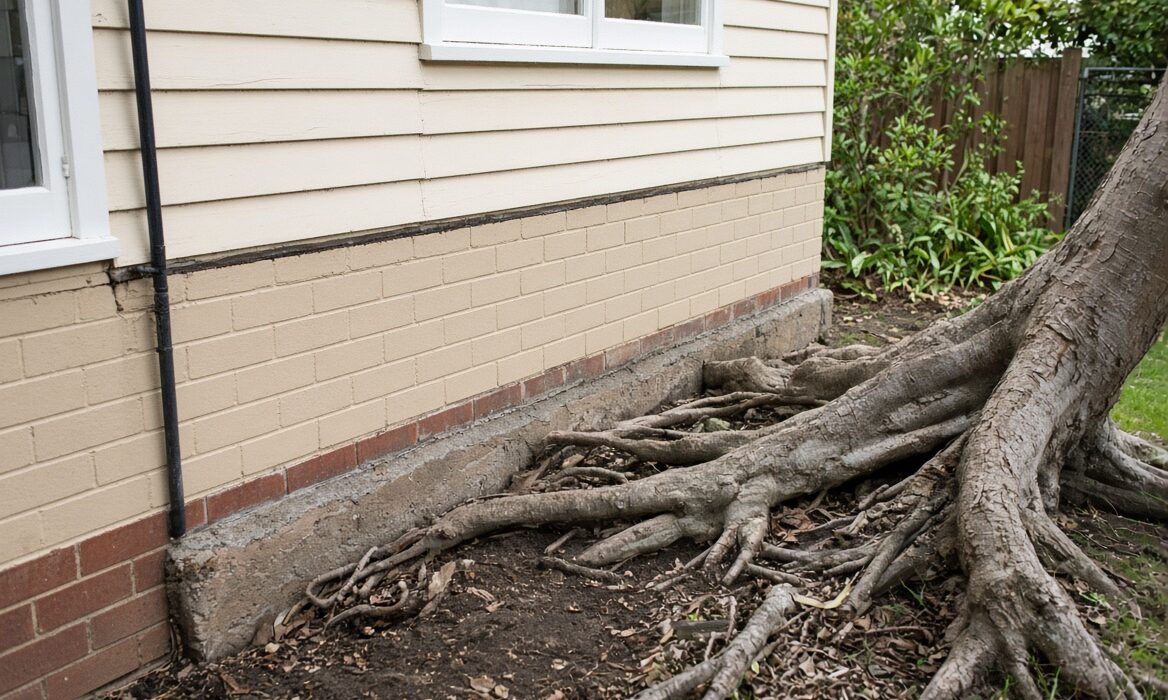
How Close Can Tree Roots Grow to House Foundations?
Tree roots are quiet invaders. While they rarely smash through solid concrete, they can still cause serious and expensive problems for homeowners. Understanding how close roots can safely grow to a foundation is one of the smartest things you can do when planting trees or managing existing ones.
Here’s a clear, practical guide based on recommendations from arborists, university extension services, and foundation experts.
How Tree Roots Actually Damage Foundations
Roots do not usually break a healthy, modern poured concrete foundation by sheer force. Damage typically happens in two main ways:
- Soil moisture changes
Large trees can remove hundreds of gallons of water from the soil every day. In clay or expansive soils, this causes the ground to shrink and settle unevenly, leading to cracks, sloping floors, and sticking doors or windows. - Exploiting existing weaknesses
Roots follow moisture and will grow into any small crack, gap, or poorly sealed joint in older foundations, sidewalks, driveways, or utility lines. As the roots thicken over the years, they widen the damage.
Tree root systems commonly spread 1.5 to 3 times the width of the canopy, and sometimes farther. A tree whose branches never touch the house can still have roots reaching the foundation zone.
Recommended Safe Distances from House Foundations
The most important factor is the tree’s mature size, not how small it looks when you plant it. Here are widely accepted guidelines:
| Tree Category | Mature Height | Recommended Minimum Distance | Examples |
|---|---|---|---|
| Small ornamental | 15–25 ft | 8–15 feet | Dogwood, redbud, Japanese maple, serviceberry, birch |
| Medium | 25–50 ft | 15–25 feet | Many maples, hornbeam, smaller oaks |
| Large shade trees | 50+ ft | 20–50 feet (30+ preferred) | Oaks, elms, tulip poplar, sycamore, large pines |
| Aggressive or water seeking species | Varies | 25–50+ feet | Silver maple, Norway maple, willow, poplar, cottonwood |
Useful rules of thumb:
- Plant the tree at least as far from the house as its expected mature height when space allows.
- Keep the trunk at least half the mature canopy width away from the foundation.
- On expansive clay soils, increase the distance, sometimes up to the full mature height of the tree.
Small evergreens such as certain arborvitae or junipers may be planted as close as 6–10 feet. Large evergreens generally need 20–40 feet of clearance.
What Increases the Risk?
Several factors make roots more likely to cause problems:
- Soil type: Clay and expansive soils amplify moisture related settling.
- Foundation age and condition: Older homes with stone, brick, or already cracked foundations are much more vulnerable than newer homes with solid concrete and good drainage.
- Tree species: Shallow, aggressive, water seeking roots such as silver maples, willows, and poplars pose higher risk than deeper rooted species like many oaks.
- Nearby utilities: Roots are strongly attracted to leaking sewer and water lines.
- Irrigation and grading: Poor drainage or watering close to the foundation can draw roots toward the house.
What If You Already Have a Tree Too Close?
Not every tree near a house needs to be removed. Many mature trees coexist safely with homes for decades. Options include:
- Having a certified arborist evaluate the tree’s health, root impact, and structural risk.
- Installing a root barrier (most effective when the tree is still young).
- Selective professional root pruning, done carefully to avoid harming or destabilizing the tree.
- Fixing existing foundation cracks and improving drainage around the house.
- Regular monitoring for new cracks, uneven floors, or doors and windows that stick.
Smart Tips for Planting Near Your Home
- Always plan for the tree’s mature size, not its current nursery size.
- Choose lower risk species closer to the house and reserve large or aggressive trees for farther areas of the yard.
- Consider installing a root barrier at planting time. It is far cheaper than dealing with problems later.
- Maintain proper grading so water drains away from the foundation.
- When in doubt, consult a local certified arborist and, if needed, a structural engineer familiar with your area’s soils.
Final Thoughts
Tree roots can grow right up to and sometimes under house foundations, but they should not be allowed to if you want to avoid potential headaches. For most situations, planting small trees 8–15 feet away and large trees 20–50 feet away gives a solid safety margin.
A well placed tree adds beauty, shade, energy savings, and property value. A poorly placed one can become an expensive problem. A little planning today protects both your home and the tree for decades to come.
If you need expert advice or professional help with trees near your property, the team at Aussie Tradies Group is here to assist. Visit https://atgltd.com.au/ to learn more or get in touch.