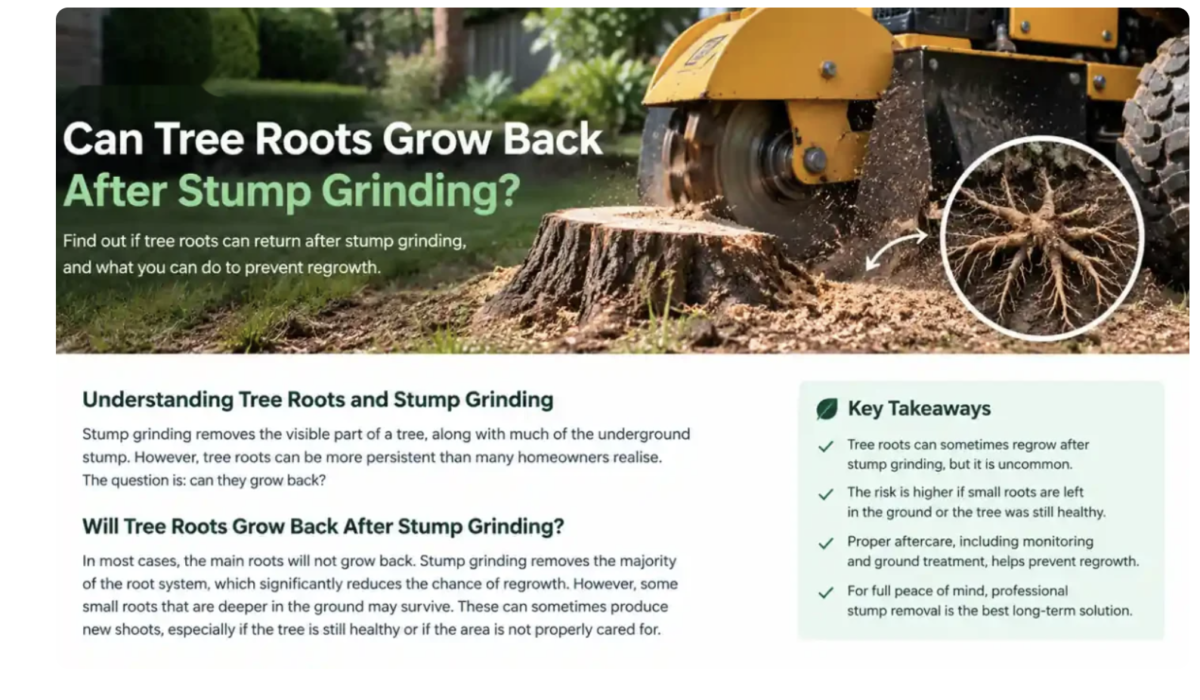
Can Tree Roots Grow Back After Stump Grinding?
Removing a tree stump does not always mean the entire underground root system disappears. After stump grinding, most of the remaining roots gradually break down naturally. However, certain tree species can produce new shoots from surviving roots, making homeowners wonder whether the tree will grow back.
So, can tree roots grow back after stump grinding? In most cases, the original tree will not regrow from its remaining roots. However, some species can develop new growth if living root sections remain underground.
Understanding how stump grinding works, why regrowth happens and what you can do afterwards will help you keep your garden clear and prevent unwanted tree growth.
What Happens to Tree Roots After Stump Grinding?
Stump grinding involves using specialised machinery to break down the visible tree stump into small wood chips. The grinder cuts through the stump and usually removes some of the surrounding surface roots, depending on the equipment and required grinding depth.
Unlike complete stump excavation, this process does not remove every underground root.
The remaining roots stay beneath the soil and gradually decompose through natural biological processes. Soil microorganisms, fungi and moisture help break down the dead wood over time.
Several factors influence how quickly the remaining roots decay:
- Tree species: Some types of wood take longer to decompose than others.
- Root size: Large and thick roots generally take longer to break down.
- Soil conditions: Moist, biologically active soil can support decomposition.
- Temperature: Warmer conditions can encourage microbial activity.
- Root depth: Deep underground roots may decompose more slowly.
In most situations, the remaining roots eventually become part of the soil rather than producing another tree.
Can Tree Roots Produce New Shoots After Grinding?
Yes, certain tree species can produce new shoots from surviving roots even after the main stump has been ground down.
This process is known as root suckering. It happens when dormant or living buds on the remaining root system begin developing into new shoots.
The likelihood of regrowth depends on several factors, including the tree species, its condition before removal and how much of the root system remains alive.
Some trees are more likely to produce unwanted shoots than others.
Examples include:
- Poplar trees
- Willow trees
- Elm trees
- Certain varieties of maple
- Some fruit trees
These species can sometimes produce new growth from surviving roots or underground sections.
However, not every tree species behaves this way. Many trees do not produce significant new growth once their main stump and growing tissues have been removed.
5 Signs That Tree Roots May Be Growing Back
After stump grinding, checking the surrounding area can help you identify unwanted regrowth early.
Here are five signs to watch for.
1. Small Shoots Appearing Around the Former Stump
One of the most noticeable signs is the appearance of small green shoots around the original stump location.
These shoots may emerge directly from surviving roots or from underground sections close to the surface.
If you notice several new shoots appearing in the same area, the remaining root system may still be active.
2. New Growth Emerging Through the Lawn
Sometimes, shoots appear several metres away from the original stump.
This can happen when a tree species produces suckers from its spreading root system.
Check the surrounding lawn regularly, especially if the removed tree was known to produce root suckers.
3. Repeated Shoot Growth After Cutting
If you remove new shoots but they continue appearing, surviving root sections may still be producing growth.
Repeated regrowth can indicate that simply cutting the visible shoots is not addressing the underlying cause.
4. Multiple Shoots Appearing in Different Locations
Some tree species have extensive root systems that can produce new growth at several points.
If multiple shoots appear around the former tree location, inspect the surrounding soil to understand where they are emerging.
5. New Growth Returning During the Growing Season
Warmer weather and suitable moisture conditions can encourage dormant buds to develop.
If the tree was removed during a cooler period, keep monitoring the area as temperatures increase.
How to Prevent Tree Roots From Growing Back After Stump Grinding
Although complete prevention depends on the tree species and condition of the remaining roots, several practical steps can reduce the likelihood of unwanted growth.
1. Choose the Correct Grinding Depth
The depth of stump grinding matters.
If the stump is only ground close to ground level, some living tissue may remain beneath the surface.
Professional operators assess the stump, surrounding ground and intended use of the area before deciding how deep to grind.
A suitable grinding depth can reduce the amount of viable stump material left behind.
2. Remove Visible Root Sections Where Necessary
In some situations, removing additional surface roots may be appropriate.
This is particularly relevant when the remaining roots are producing unwanted shoots or interfering with landscaping.
However, removing large roots can disturb nearby structures, underground services and surrounding plants.
Professional assessment is recommended before excavating extensive root systems.
3. Monitor the Area for New Shoots
Regular monitoring helps identify regrowth before it becomes established.
Check the former stump location and surrounding garden for new shoots, particularly during warmer months.
Remove small shoots promptly using an appropriate method for the tree species.
If new growth keeps returning, seek professional advice about treating the remaining root system.
4. Avoid Planting Immediately Over Unstable Ground
After grinding, the remaining wood chips and underground root material will gradually decompose.
As this happens, the ground can settle.
If you plan to install new turf, paving or garden features, consider allowing the area to settle and preparing the soil properly first.
5. Consider Complete Stump Removal When Appropriate
Stump grinding is suitable for many residential properties, but it does not remove the entire root system.
If complete removal is necessary because of persistent regrowth, construction plans or particular landscaping requirements, excavation may be a better option.
A professional can assess whether additional removal is practical and safe.
Does Stump Grinding Kill Tree Roots?
Stump grinding removes the main stump and destroys much of the above-ground stump material. It generally prevents the original tree from continuing normal growth.
However, the process does not automatically kill every underground root.
Some roots may remain alive temporarily, particularly in tree species capable of producing root suckers.
Other roots stop functioning once they lose their connection to the living stump and gradually decompose underground.
The important difference is that removing the visible stump and eliminating every living root are not the same thing.
If your priority is preventing regrowth, the tree species and remaining root condition should be considered before deciding on further treatment.
How Long Do Tree Roots Take to Decompose After Stump Grinding?
There is no fixed timeframe for underground roots to disappear completely.
Smaller roots may break down relatively quickly, while larger roots can remain underground for several years.
The decomposition process depends on:
- The original tree species.
- The thickness and quantity of remaining roots.
- Soil moisture and drainage.
- Soil microorganisms.
- Local environmental conditions.
As the wood decomposes, the soil above the old root system may gradually settle.
This is normal and does not necessarily indicate that the tree is growing back.
Is Stump Grinding Better Than Complete Stump Removal?
Both methods have advantages, depending on the condition of the tree and how you intend to use the space.
Stump Grinding
Stump grinding is often suitable when you want to remove an unwanted stump without excavating a large section of your garden.
Benefits include:
- Less disruption to surrounding landscaping.
- No need to excavate the entire root system.
- Faster restoration of the affected area.
- Space for future lawn or garden improvements.
- Effective removal of the visible stump.
Complete Stump Removal
Complete stump removal involves excavating the stump and associated root material.
It may be more suitable when:
- Persistent root suckering is a problem.
- The area is needed for construction.
- Large root sections are obstructing landscaping.
- The remaining stump material must be removed.
However, excavation can disturb more soil and nearby landscaping.
The best option depends on your property, tree species and future plans for the area.
When Should You Call a Professional?
Although small amounts of natural decomposition are expected after stump grinding, recurring shoots or extensive root problems may require professional attention.
Consider contacting a tree care professional if:
- New shoots continue appearing around the old stump.
- Roots are spreading into unwanted garden areas.
- You are planning construction near the former tree location.
- The remaining roots are affecting paving or landscaping.
- You are unsure whether grinding or excavation is appropriate.
Professional assessment helps identify the source of regrowth and determine the most suitable solution.
Final Thoughts
Tree roots can sometimes produce new shoots after stump grinding, but this depends largely on the species and condition of the remaining root system.
In most cases, the original tree will not return, and underground roots gradually decompose naturally. However, certain species may produce root suckers that require additional attention.
If you have an unwanted tree stump on your property, choosing the right removal method can make a significant difference.
Aussie Tradies Group (ATG) provides professional tree care solutions to help Melbourne property owners manage unwanted stumps and maintain safer outdoor spaces.
Contact our team to discuss your stump grinding requirements and find the right solution for your property.
Frequently Asked Questions
1. Can a tree grow back after stump grinding?
Some tree species can produce new shoots from surviving roots. However, most trees will not regrow once the main stump and growing tissues have been removed.
2. Do underground tree roots die after stump grinding?
Many remaining roots gradually die and decompose after losing their connection to the living stump. Some species can retain the ability to produce new shoots.
3. How long does it take for roots to rot after stump grinding?
Smaller roots may decompose relatively quickly, while larger roots can take several years. The timeframe depends on tree species, root size and soil conditions.
4. Should I remove the roots after stump grinding?
Not necessarily. Most remaining roots can decompose naturally. Additional removal may be appropriate if roots cause problems or continue producing unwanted shoots.
5. Can I plant grass where a tree stump was ground?
Yes. Once the area has been properly prepared and filled with suitable soil, grass can generally be planted. Allow for some ground settling as the remaining wood material decomposes.