Tree Stump Removal vs Stump Grinding: Which Option Is Best?
After a tree has been cut down, the remaining stump can become an obstacle in your garden, affect your landscaping plans, and create difficulties when maintaining your lawn. Choosing between tree stump removal vs stump grinding depends on your property, the size of the stump, your budget, and what you want to do with the area afterwards. Although both methods deal with unwanted tree stumps, they use different techniques and produce different results. Understanding these differences can help you select the most suitable option for your outdoor space and avoid unnecessary costs.
What Is Tree Stump Removal?
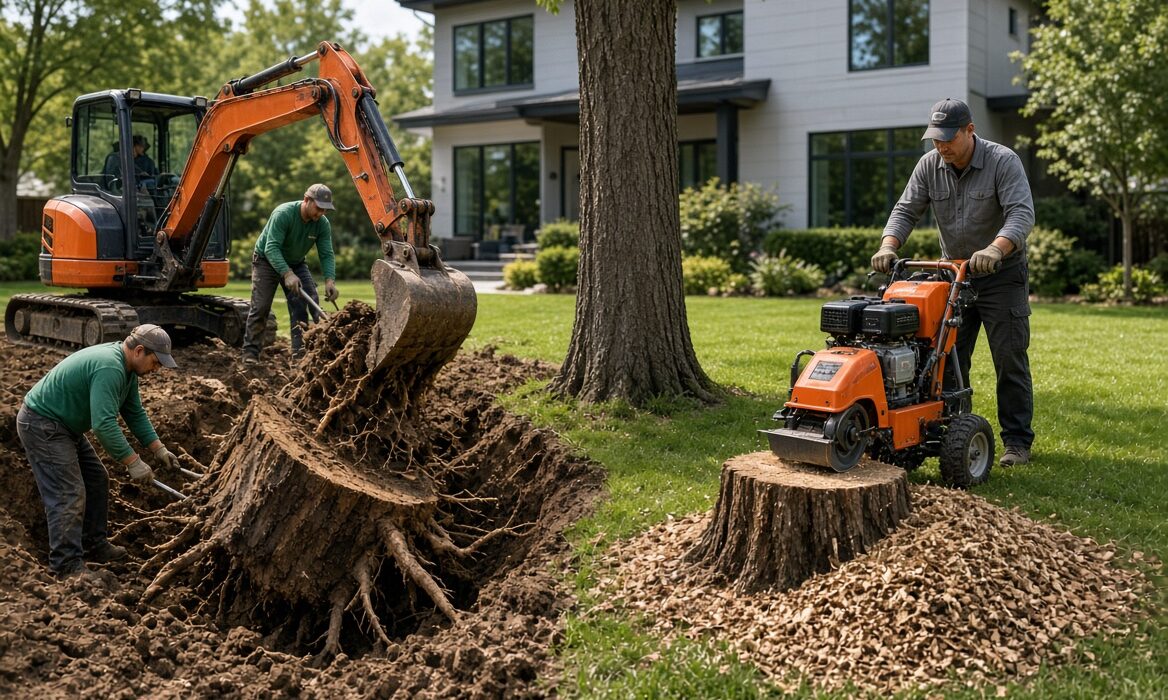
Tree stump removal involves extracting the stump and, depending on the method used, a substantial portion of its root system from the ground. This process may require specialised machinery, excavation, cutting equipment, and the removal of soil and woody material.
Unlike grinding, which reduces a stump to small wood chips below ground level, complete stump removal focuses on physically taking the stump out of the ground.
How Does Tree Stump Removal Work?
The exact process depends on the stump’s size, tree species, root structure, soil conditions, and accessibility.
A typical stump removal process includes:
- Assessing the stump: A professional evaluates the stump’s dimensions, surrounding structures, underground services, and visible roots.
- Preparing the site: The work area is cleared of obstacles to provide safe access for equipment.
- Excavating around the stump: Soil is removed to expose the stump and important root sections.
- Cutting and extracting roots: Suitable tools or machinery are used to separate and remove the stump and accessible roots.
- Clearing the area: The extracted wood and remaining debris are removed, and the ground is prepared for the next stage of landscaping.
The amount of root material removed varies. Even when the stump is extracted, some smaller or deeper roots may remain underground.
Advantages of Tree Stump Removal
1. Removes the main stump
Physical extraction removes the central stump rather than simply grinding it below the soil surface. This can be useful when you want to eliminate a substantial woody obstruction.
2. Supports certain landscaping projects
If you are planning major landscaping, installing some types of foundations, or changing the layout of your garden, stump extraction may be appropriate where the remaining stump or roots would interfere with the work.
3. Allows access to the space occupied by the stump
Removing the stump can make it easier to prepare the area for construction or other projects, although additional excavation, soil replacement, and ground preparation may still be necessary.
4. Reduces the amount of large woody material left underground
Because the main stump is extracted, there is less substantial stump material remaining in the excavated area. However, smaller roots can still decay over time.
Disadvantages of Tree Stump Removal
Complete stump extraction is not always the most practical choice.
- More excavation: The process may disturb a larger area of lawn, garden beds, or surrounding soil.
- Potentially higher costs: Labour, machinery, root extraction, waste disposal, and ground restoration can increase the total price.
- Access limitations: Large machinery may be difficult to use in narrow gardens or confined residential properties.
- Damage to surrounding landscaping: Nearby plants, paving, irrigation systems, and lawn areas may be affected during excavation.
- Incomplete root removal: Deep or extensive roots may be impractical to extract entirely.
For these reasons, professional assessment is important before choosing complete stump removal.
What Is Stump Grinding?
Stump grinding is a process that uses a specialised machine with a rotating cutting wheel to break down the remaining tree stump into small wood chips. The machine gradually reduces the stump to a specified depth below the surrounding ground level.
This method generally avoids the extensive excavation associated with physical stump extraction. It is often a practical option for residential properties where the main objective is to remove the visible stump and reclaim usable outdoor space.
How Does Stump Grinding Work?
A professional stump grinding service generally follows these steps:
- Inspecting the stump: The operator assesses its size, position, condition, and accessibility.
- Checking the work area: Potential underground hazards, nearby structures, and obstacles are considered before machinery is used.
- Positioning the grinder: The equipment is positioned to reach the stump safely.
- Grinding the wood: The cutting wheel gradually reduces the stump and, where required, the upper root flare below ground level.
- Managing the wood chips: The resulting material is collected or left for suitable reuse, depending on the agreed service.
- Preparing the ground: The area is levelled or backfilled as appropriate, ready for further landscaping.
The required grinding depth depends on the intended use of the space. A lawn may need a different preparation depth from a garden bed or a planned construction area.
Advantages of Stump Grinding
1. Less ground disturbance
Stump grinding typically removes less surrounding soil than complete extraction. This can help preserve nearby lawns, garden beds, and established landscaping.
2. Efficient for many residential properties
For accessible stumps of suitable size, grinding can be completed without excavating the entire stump and its larger roots. The time required varies with the tree species, stump dimensions, equipment, and site conditions.
3. Often more economical
Grinding can be more affordable than complete stump extraction because it generally involves less excavation and root removal. The actual price depends on stump size, access, the number of stumps, and the depth required.
4. Helps reclaim garden space
Once the stump has been ground below ground level and the area has been prepared, the space can often be used for lawn restoration, planting, or other landscaping purposes.
5. Suitable for many tight spaces
Compact stump grinders can access some locations where larger excavation equipment may struggle. However, access requirements and equipment dimensions should be confirmed before work begins.
Disadvantages of Stump Grinding
Stump grinding has several limitations to consider.
- Roots remain underground: The main stump is ground down, but the wider root system is generally left in place.
- Wood chips require management: The resulting chips may need to be removed, reused, or incorporated into an appropriate landscaping plan.
- Ground settling can occur: As residual roots decay, the soil may gradually settle in the affected area.
- Not ideal for every construction project: Grinding alone may not provide the clear ground or verified soil conditions required for foundations and certain other building work.
- Regrowth may occur in some species: Certain trees can produce new shoots from surviving roots, even after the stump has been ground.
A professional can explain whether grinding will meet your requirements or whether additional excavation is necessary.
Tree Stump Removal vs Stump Grinding: Key Differences
Although both services help eliminate unwanted stumps, their main differences involve the removal method, ground disturbance, cost, and how the area can be used afterwards.
| Comparison | Tree stump removal | Stump grinding |
|---|---|---|
| Main method | Excavates and extracts the stump | Grinds the stump into wood chips |
| Main stump | Physically extracted | Reduced below ground level |
| Root system | Main and accessible roots removed as needed | Most roots remain underground |
| Soil disturbance | Generally greater | Generally lower |
| Cost | Often higher | Often lower |
| Landscaping impact | May disturb a wider area | Usually preserves more surrounding ground |
| Lawn restoration | Requires filling and levelling the excavation | Requires managing chips and preparing the ground |
| Construction preparation | May be preferable where stump extraction is required | May be insufficient if deeper roots or stump material must be removed |
| Best suited for | Projects needing physical stump extraction | Many routine residential stump-clearing jobs |
The most suitable method depends on your property’s needs rather than the assumption that one option is always better.
Which Option Is More Affordable?
Cost is often one of the biggest factors when comparing stump removal vs grinding. In many situations, stump grinding costs less because it does not require the same level of excavation and root extraction.
However, the final price depends on several factors.
Stump Size and Tree Species
Large stumps generally require more time and effort to process. Hardwood stumps can also take longer to grind than some softer woods. Extensive root systems may increase the work required for physical extraction.
Number of Stumps
Removing or grinding multiple stumps during one visit may offer better value than arranging separate appointments. The savings depend on the distance between stumps, access, and the equipment needed.
Site Accessibility
A stump located in an open front yard may be easier to access than one positioned behind a narrow gate, beside a retaining wall, or near delicate landscaping. Restricted access may require smaller equipment or additional labour.
Root System and Excavation Requirements
If the stump has large surface roots or deep roots that need to be extracted, complete removal can require considerably more work. Grinding usually focuses on the stump and the depth needed for the intended use of the area.
Waste Removal and Ground Restoration
The quoted service may or may not include the removal of wood chips, disposal of extracted material, replacement soil, and final levelling. Confirming these details helps you compare estimates accurately.
Cost-saving tip: Request a quote that clearly specifies the method, grinding or excavation depth, debris disposal, and site restoration. This makes it easier to compare services based on the complete job rather than the initial price alone.
Which Method Is Best for Your Garden?
The right option depends on what you intend to do with the space after the stump is dealt with.
If You Want to Restore Your Lawn
Stump grinding is often suitable when a stump is located in a lawn and your goal is to reclaim the space. After grinding, the wood chips can be managed and the area prepared with suitable soil before new grass is established.
The depth of grinding and ground preparation should match the type of lawn restoration planned.
If You Want to Plant Flowers or Shrubs
Grinding can be a practical option for many garden beds. However, the remaining roots may occupy space and affect where new plants can be positioned. Large quantities of fresh wood chips should not automatically be mixed into planting soil, as their decomposition can affect soil conditions.
For a planting project requiring a completely clear area, stump extraction may be more suitable.
If You Plan to Install Paving or Build a Structure
Construction and hardscaping projects require more careful planning. Simply grinding a stump below the surface does not guarantee that the soil is suitable for a foundation, paving base, retaining structure, or other load-bearing installation.
Depending on the project, the contractor may require excavation, removal of additional roots, suitable fill, and proper compaction. Consult the relevant building or landscaping professional before selecting a stump treatment method.
If You Have Limited Garden Access
Grinding may be preferable when the stump is in a confined area and a suitable compact machine can reach it. Physical extraction may require more room for excavation and equipment.
A site inspection can help determine which machinery is appropriate without causing unnecessary damage to nearby features.
What Happens to Tree Roots After Stump Grinding?
One of the most common questions homeowners ask is whether tree roots disappear after stump grinding.
The answer is no. Grinding removes the stump to the required depth, but most of the root system remains underground.
Over time, the remaining roots generally decompose through natural biological processes. The speed of decomposition depends on the tree species, root size, soil moisture, temperature, and activity of soil organisms.
As roots break down, they may leave small voids in the soil. These can contribute to gradual ground settlement, particularly where larger roots remain.
If your project requires a stable, prepared surface, you may need additional soil preparation or root removal. Do not assume that a ground stump means every underground root has been removed.
Can Tree Roots Grow Back After Grinding?
Some tree species can produce shoots from surviving roots or other living tissue. Grinding the central stump reduces the main source of growth, but it may not eliminate every living root.
If regrowth appears, the appropriate response depends on the species and the extent of the growth. A tree professional can recommend suitable management options.
Where regrowth is a concern, discuss the tree species and its growth habits with your stump grinding provider before work begins.
Is Stump Grinding Better for the Environment?
Both stump grinding and physical extraction can be reasonable options, depending on the site and the intended outcome.
Stump grinding often causes less immediate soil disturbance because it does not require excavating the entire stump and major roots. This may help preserve surrounding vegetation and reduce the amount of soil that needs to be replaced.
The wood chips produced by grinding can sometimes be reused as surface mulch around suitable garden areas or managed through green-waste services. However, they should be used appropriately, particularly if the tree was diseased or the chips contain material unsuitable for the intended planting area.
Physical stump extraction removes more of the central woody material but may disturb a larger section of the garden. The extracted material also needs to be transported, recycled, or disposed of properly.
The environmentally preferable option depends on the condition of the stump, the tree’s health, the condition of the soil, and how the site will be used after the work.
When Should You Hire a Professional Stump Removal Service?
Although a small stump may appear manageable, large stumps and extensive root systems can be difficult to handle without suitable equipment and experience.
Consider hiring a professional when:
- The stump is large or made from dense hardwood.
- The stump is close to buildings, fences, retaining walls, or paved surfaces.
- The roots extend beneath nearby structures or garden features.
- Access is restricted and specialist machinery is required.
- The stump is close to underground utilities.
- You plan to construct, pave, or significantly landscape the area.
- The tree may have been affected by disease and the resulting material requires careful handling.
Before grinding or excavating, underground utility locations should be checked as appropriate. Operators also need to manage flying wood chips, machinery hazards, and nearby people or property.
Professional equipment and a suitable work plan can help reduce risks and produce a better result.
Frequently Asked Questions
Is stump grinding the same as stump removal?
No. Stump grinding uses a cutting wheel to reduce the stump below ground level, leaving most roots in the soil. Physical stump removal involves excavating and extracting the main stump and accessible root material.
Is stump grinding cheaper than stump removal?
Stump grinding is often less expensive because it generally requires less excavation and labour. However, stump size, access, tree species, grinding depth, and disposal requirements can affect the total cost.
Can I plant a new tree where a stump was ground?
It may be possible, but the remaining roots and wood chips can affect planting conditions. You may need to remove additional material, prepare fresh soil, or choose a different planting location based on the new tree’s needs.
How long does stump grinding take?
The time required varies with the stump’s size, wood density, location, equipment access, and desired depth. A small, accessible stump may take much less time than a large hardwood stump with extensive surface roots.
Does stump grinding remove all the roots?
No. Stump grinding generally removes the main stump and selected root sections near the surface. Most of the wider root system remains underground and decomposes gradually.
Will grass grow after stump grinding?
Grass can often be established after the area has been prepared. This usually involves managing the wood chips, adding suitable topsoil, levelling the surface, and following appropriate lawn establishment practices.
Can a stump be removed without damaging the lawn?
Some disturbance is possible with either method. Grinding typically affects a smaller area than extensive excavation, but the machine still needs sufficient access and a suitable working surface. A professional can recommend the least disruptive method for your garden.
Choose the Right Stump Service for Your Property
Choosing between tree stump removal vs stump grinding comes down to your goals, the stump’s condition, and how you intend to use the space. Grinding is often a practical, cost-effective option for reclaiming lawn and garden areas, while physical extraction may be better when a project requires the main stump and accessible roots to be removed.
Before making a decision, consider the stump’s size, site access, potential underground hazards, restoration requirements, and the possibility of root regrowth. A professional assessment can help you understand the options and avoid paying for work that does not meet your needs.
Ready to clear an unwanted tree stump? Contact our team to discuss your property, compare stump grinding and removal options, and arrange a suitable solution for your outdoor space.